Neuropathology
) Neuropathology
The Neuropathology and Biobank Platform corresponds to the activity that the CIEN Tissue Bank (BT-CIEN), a neurological tissue bank created by CIEN in 2010, dedicates to the research programmes of the centre itself. This activity focuses, on the one hand, on the extraction and processing of post-mortem brain tissue donated to the biobank, the diagnosis and classification of donated brains from a neuropathological point of view, and the transfer of samples to external researchers. On the other hand, the biobank develops research projects in the neuropathological field, in collaboration with other CIEN platforms and other research centres.
As an active biobank within the framework of the current regulations on the management of human biological samples, the BT-CIEN has a Scientific Director (Alberto Rábano), a Coordinator (Laura Saiz) and two external committees, scientific and ethical, respectively.
The BT-CIEN develops an internal donation programme, aimed at patients at the Queen Sofia Foundation Alzheimer Centre, which is part of the Vallecas Alzheimer Queen Sofia Study (VARS), and an external donation programme, aimed at potential donors in the Community of Madrid and other Autonomous Communities that do not have their own neurological tissue bank.
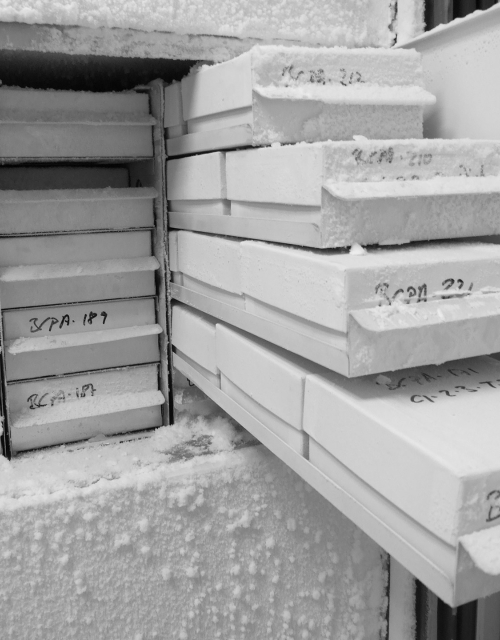
The CIEN Neuropathology and Biobank Platform has adequate facilities for clinical autopsies, for processing post-mortem brain tissue and for the neuropathological diagnosis of donated tissue (autopsy room, carving room, dry and wet storage rooms). The biobank also has a high storage capacity for frozen biological samples, including brain tissue, cerebrospinal fluid and other types of samples from donations, as well as numerous blood and blood product samples from the VARS and other CIEN research cohorts.
For more information about CIEN Tissue Bank: https://bt.fundacioncien.es/

The working team of the Neuropathology and Biobank Platform (CIEN Tissue Bank), led by Dr. Alberto Rábano, is multidisciplinary (doctors, biologists, technicians and administrative staff) and is made up of the following professionals dedicated to management, neuropathology and research:
Specialist in Pathological Anatomy and Doctor of Science. Scientific Director of the CIEN Tissue Bank.
Biology Graduate. BT-CIEN Coordinator
Neuropathology Technician / Extractions Alert
Graduate in Medicine and Surgery, specialist in Neurology and Pathological Anatomy
Graduate in biology, specialist in neuroscience. PhD student.
BT CIEN Secretariat
Neuropathology Technician / Extractions Alert
Neuropathology Technician
Neuropathology Technician
Lines of research
- Study of neuropathological and molecular phenotypes in Alzheimer's disease and other related dementias.
- Neuropathological and molecular classification of tauopathies, especially those associated with advanced age.
- Clinicopathological correlations in patients with dementia.
- Combination and interaction of Alzheimer's type pathology with cerebrovascular pathology and other copathologies.
- Other pathological entities associated with old age (e.g. hippocampal sclerosis).
-
View publication
Neuropathological Heterogeneity of Dementia Due to Combined Pathology in Aged Patients: Clinicopathological Findings in the Vallecas Alzheimer's Reina Sofía Cohort.
J Clin Med. 2024 Nov 10;13(22):6755. doi:10.3390/jcm13226755. PMID: 39597898.
Analyzes the neuropathological heterogeneity of dementia in older adults with combined pathologies, based on 167 cases from the Vallecas Alzheimer's Reina Sofía cohort (VARSpath). -
View publication
Serum GFAP levels correlate with astrocyte reactivity, post-mortem brain atrophy and neurofibrillary tangles.
Brain. 2024 May 3;147(5):1667-1679. doi:10.1093/brain/awae035. PMID: 38634687.
Studies the relationship between serum GFAP levels, astrocyte reactivity, post-mortem brain atrophy and the presence of neurofibrillary tangles. -
View publication
A novel histological staging of hippocampal sclerosis that is evident in gray matter loss in vivo.
Alzheimers Dement. 2023 Jul;19(7):3028-3040. doi:10.1002/alz.12942. PMID: 36691755.
Presents a new histological staging of hippocampal sclerosis and shows its correspondence with gray matter loss observable in vivo through neuroimaging techniques. -
View publication
Association of CD2AP neuronal deposits with Braak neurofibrillary stage in Alzheimer's disease.
Brain Pathol. 2022 Jan;32(1):e13016. doi:10.1111/bpa.13016. PMID: 34514662.
Investigates the distribution of CD2AP neuronal deposits in the brains of people with Alzheimer's disease and their association with Braak stages, which reflect the progression of neurofibrillary pathology. -
View publication
Impact of neurodegenerative diseases on human adult hippocampal neurogenesis.
Science. 2021 Nov 26;374(6571):1106-1113. doi:10.1126/science.abl5163. PMID: 34672693.
Analyzes the impact of different neurodegenerative diseases on human adult hippocampal neurogenesis, identifying alterations in the development of new neurons and in the balance of neural stem cells. -
View publication
Non-productive angiogenesis disassembles Aβ plaque-associated blood vessels.
Nat Commun. 2021 May 25;12(1):3098. doi:10.1038/s41467-021-23337-z. PMID: 34035282.
Investigates the vascular mechanisms associated with beta-amyloid plaques in Alzheimer's disease. Shows that non-productive angiogenesis promotes the breakdown of plaque-associated blood vessels and that microglia participate in the removal of endothelial cells. -
View publication
Medial Temporal Lobe Involvement in Human Prion Diseases: Implications for the Study of Focal Non Prion Neurodegenerative Pathology.
Biomolecules. 2021 Mar 10;11(3):413. doi:10.3390/biom11030413. PMID: 33802224.
Analyzes medial temporal lobe involvement in human prion diseases and its implications for the study of focal, non-prion neurodegenerative pathologies. -
View publication
Adult hippocampal neurogenesis is abundant in neurologically healthy subjects and drops sharply in patients with Alzheimer's disease.
Nat Med. 2019 Apr;25(4):554-560. doi:10.1038/s41591-019-0375-9. PMID: 30911133.
Shows that adult hippocampal neurogenesis remains active in neurologically healthy people but declines markedly in patients with Alzheimer's disease, providing insight into the cellular changes associated with the disease. -
View publication
Polymicrobial Infections In Brain Tissue From Alzheimer's Disease Patients.
Sci Rep. 2017 Jul 17;7(1):5559. doi:10.1038/s41598-017-05903-y. PMID: 28717130.
Investigates the possible presence of polymicrobial infections in the brain tissue of Alzheimer's disease patients using immunohistochemical and molecular techniques, identifying bacterial material in the analyzed samples. -
View publication
Combined Alzheimer's Disease and Cerebrovascular Staging Explains Advanced Dementia Cognition.
Alzheimers Dement. 2015 Nov;11(11):1358-1366. doi:10.1016/j.jalz.2015.01.004. PMID: 25804997.
Analyzes how combining the neuropathological staging of Alzheimer's disease with cerebrovascular pathology better explains the cognitive status of people with advanced dementia.